Category Archives: Teens

Spread the word about 9-8-8!

Please note that this blog post talks about suicide and suicide prevention.

In the world of mental health, sometimes something so fantastic happens that therapists just have to write about it. 9-8-8 is just that exciting.

On November 30, 2023, media outlets across Canada were bursting with the news. The phone number 9-8-8 was launched! Its mandate is to deliver culturally-appropriate suicide prevention services in both official languages to anyone living in Canada at any time of the day (24 hours a day, 7 days a week). Funded by the Government of Canada, the service is delivered through the Centre for Addiction and Mental Health (CAMH) and its 39 local and national partners across the country.

Callers can be people who are thinking about suicide or people who are worried about someone who is at risk of suicide.

Thanks to the network of partners behind 9-8-8, when you call or text, your call is answered by a responder who is knowledgeable about your local community, its specific needs, and its resources. Callers with more specialized needs (children, teens and Indigenous Peoples, for example) can select to speak with counsellors directly trained to work with their populations. Children and teens can speak to Kids Help Phone and First Nations, Inuit and Metis can speak to Hope for Wellness Helpline. Callers can also select ASL/LSQ support.

When someone is talking about suicide, 9-1-1 support is often not needed. If it is though, because of urgent or imminent risk to the caller or someone else, the 9-8-8 responder stays in contact with the caller until 9-1-1 help arrives.

To wrap up, the website 988.com is worth a visit. It provides clear guidelines about how to support someone who is thinking about suicide – and it asks that Canadians spread the word about 9-8-8. Which is exactly what I am doing. (It also provides some nifty downloads to use as posters, wallet cards, and posts to social media!).

For more details, please have a look at the following websites: Language Matters: Safe Communication for Suicide Prevention (Public Health Agency of Canada), Centre for Addiction and Mental Health, and the Canadian Radio-television and Telecommunications Commission (for its announcment of 9-8-8),

And please spread the word.

Why is my son not like my daughter?

This is often the opening conversation I have with parents:

Parent: I am worried about my son. He is messy. He doesn’t do his homework until the last minute (if at all). He procrastinates until the night before something is due then scrambles to get it done. He is not really motivated to do his best at school. He does the bare minimum and then complains about the work.

Margot: Do you have any other children?

Parent: Yes, we have a daughter. She is a very hard worker. We never have to worry about her. Her grades are good and she always tries her best.

Margot: Ahhhh. There is the problem. If you compare your son to your daughter, you will be worried. Let’s talk about how boys are different than girls.

 Of course, if you compare all boys to what you are about to read, you will find lots of exceptions. Not all boys work to deadlines, aim to do just enough to keep off everybody’s radar, and kick into action only when they have a good reason to do so. But enough of them follow that path to warrant this blogpost.

Ambition and motivation: Boys do have ambition and are motivated but just not with the things parents want, like getting high marks and taking piano lessons. They are much more “in the moment”, enjoying the defeat of their on-line video games competitors or watching the Stanley Cup finals. They will study but this might happen the night before the test and they will do homework but only if the teacher is marking it. I sometimes describe this as “mercenary”: they are motivated when there is something in it for them.

Which is the reason why it is so important to help your son figure out early on what he really wants to do after high school. Grade 10 Careers class is a great time for this to happen (and earlier if you can manage it) as it is the marks in Grade 11 and 12 that count towards university acceptances in Ontario. And you do this by paying attention to what really motivates him. Maybe it is political disagreements, or graffiti art, or soccer statistics, or writing rap songs. It doesn’t really matter what it is – the important part is helping him see how these passions can actually become his career! When boys have a goal they will work towards it and if they know they need an 85% average to get into the university program that intrigues them, they will aim for 85% (which drives parents crazy – why not aim a little higher than the bare minimum?? – but remember it is better than the alternative).

Organization and time management: More and more, I am hearing from academic coaches that boys don’t really start taking notice of how to organize themselves better until around the time they are figuring our what they want to do after high school – Grade 9 or Grade 10. Teach a boy in Grade 7 how to set up his agenda, and he may be thankful in the moment but never use it again. Set up a boy in September with a new binder, dividers and paper and by the end of September, you will need to spend time to set it up again, if he still can find the binder. You have to keep role modelling and not give up. But don’t despair if your son is not picking up on all the great organizational tools you are showing him. He will put them in place when he thinks he needs them – but this may take a few years.

Love your boy the way he is: It is easy to compare your son to your daughter or to your friends’ daughters and wish he were more like them. The basic learning is that he isn’t! And any amount of nagging, begging, pestering and guilt tripping you do to try and make him like her may only serve to create a rift. I suggest to parents to focus instead on the relationship and keeping that strong and positive. Because when you spend important time with your son, you can observe what makes him motivated, you can talk to him about how he wants to change the world, and you can help him put the steps in place to get there.

So while you may be feeling frustrated about the choices your son is making at the current time, be careful not to discount his potential, creativity, passion and skills. He will find the drive to follow his ambition, but it will happen in his own time and when he is ready to commit to his path.

Timeouts for Parents

The concept of timeouts is as varied as the number of authors who write about them. Thomas Phelan. author of “1-2-3 Magic”  was my “go to” expert when my children were small. I read and re-read whole sections of this book. More recently, Dan Siegel has replaced the idea of timeouts with the idea of time-ins, speaking to the concept that when our children are at their most vulnerable emotionally we ask them to go sit on a stair for 5 minutes and think about their choices. Instead in his book “No-Drama Discipline” he strongly suggests we give children the support they need in their most trying moments by keeping them close to us, rather than pushing them away.

This blogpost is about another type of timeout – one for parents – and not necessarily when our own emotions are on full blast. By taking a timeout each day for our own needs, we create a state of mind that can stay calm, cool and collected when our children are demanding, angry or just plain irritating. In essence, the idea is that we fill our own emotional bucket before it gets depleted by the needs of other people in our family.

Perhaps this is taking 30 minutes after lunch when everyone goes to their own quiet space in the house, including the parents, to do their own thing. For children, this could mean reading quietly or doing a puzzle. For adults, this might also mean reading or it could be doing a yoga routine, catching up with a friend on the phone, or relaxing with a cup of tea. A timeout could also take the form of a daily run or workout class, a quiet time after dinner to go for a walk by yourself with the dog, or ensuring you have 30 minutes before bed to do something important for you (and not washing the dishes or checking email).

If we are to be present emotionally for our children, we first must take care of our own emotions. It is a well-worn metaphor, but the directions of the flight attendants on an aircraft to put your own oxygen mask in place before helping anyone else is important for not just airplane trips. It is important each and every day. So consider what your emotional oxygen mask might be and then proceed by giving yourself a well deserved daily timeout.

Ending the Nightly Homework Battle

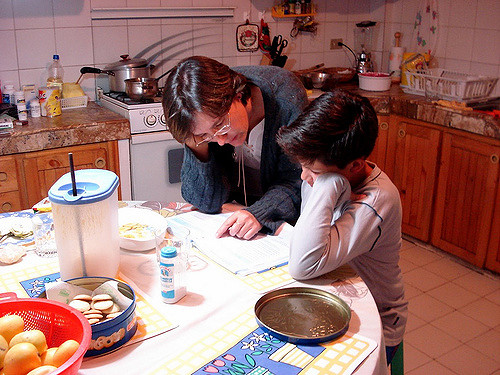
A few years ago, I overheard a teacher say to a student: “Home—–work. What part of that don’t you understand?” The answer might be all of it!

Few families get through homework each night without the homework battles beginning, but why?

  • At the end of the day, parents are tired and kids are tired
  • Hockey, girl guides, swimming, skating, dance class, tutoring, family events … need I say more?
  • Difficult instructions, lost handouts, missing textbooks, confused due dates
  • And kids don’t believe that their parents might know a little about Grade 3 math or Grade 8 Geography: “Mom (or Dad), you don’t get it! That’s not the way we are supposed to do it!!”

Wow! The potential for a perfect storm brews in your home every night. Here are a few ideas for how to take the battle out of homework.

Timing is everything…

  • Try to establish a regular homework time as often as you can – snack >> homework >> dinner >> reading >> bed. The more homework your child can accomplish before dinner, the better his or her mood, attention and focus will be.
  • If your child is an early riser and there is time in the morning before leaving for school, shift some of the work to this time, especially subjects that are more difficult.
  • Help your child use their agenda as a planning tool, not just a homework list. Work backwards from the due date. If the test is on Friday, begin studying on Tuesday or Wednesday. If the book report is due on Monday, finish the book a week before and begin writing a section each night, leaving proofreading and assembling the final report for the weekend.

Location is everything … 

  • Few children, especially younger ones, do their best work secluded in their bedrooms. There are simply too many distractions – lego, the cat, a hole puncher. Anything can be a distraction if you are trying to avoid your work.
  • Create an “office” near the kitchen so that as you make dinner you can supervise from a distance and keep re-directing when necessary.
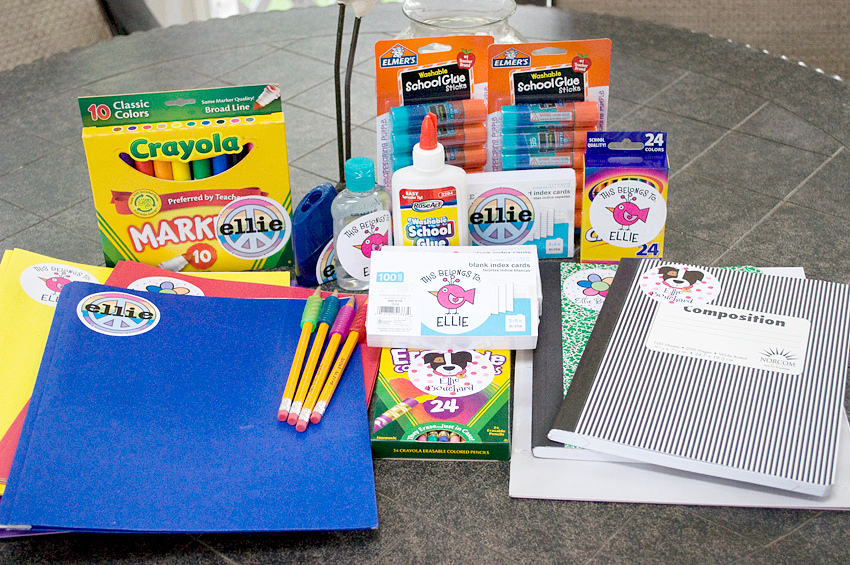
  • Stock this “office” with everything your child will need to be successful: lined paper, pencils and a sharpener, erasers, pens, pencil crayons, markers, post-it notes, glue, tape, and a hole puncher. Don’t let something minor like the correct colour of pencil crayon stand between your child and their success with their homework.
  • Keep all electronics on the main floor and out of your children’s bedrooms – computers, laptops, iPads, televisions, phones – so you can oversee appropriate usage. Many students, even young ones, tell me about how often their electronics get in the way of them finishing their homework fast and carefully. As your children get older, this can be a point of negotiation based on successful and repeated homework completion!

Attitude is everything …

  • If your child feels that they don’t understand their homework, empower them in other ways. Have them write a note in their agenda or an email to the teacher, asking for help the next day rather than you taking on this job.
  • Encourage your child to visit their school library or library’s website for links to age appropriate databases for researching topics.
  • Bookmark a few websites on your home computer that will be helpful for your child to use if they get stuck – for example, https://ca.ixl.com/ (membership required) for Math and Language Arts, https://www.khanacademy.org/ for Math, http://kiddle.co/ for researching, https://www.raz-kids.com/ (membership required) for reading and http://www.bbc.co.uk/schools/primarylanguages/french/ for French
  • Before jumping in and solving an issue, tell your child that you are confident they can solve the situation – and if they need a little adult support they can ask you after they have tried first.
  • When necessary, if you feel you need to communicate with your child’s teacher, take a team approach, asking the teacher to work with you to solve the homework battle together.

And if the homework battles continue to rage, it might be time to enlist the help of a counsellor, learning coach, or tutor so that the relationship you have with your child is not spoiled by spelling tests, division questions or history projects.


Reframing Poor Marks At School

Earlier today a friend sent me a photo of the view from her beach chair in Mexico: sand in the foreground, blue sky and kite sailing further away. I was immediately transported to her view and could feel the warmth of the sun and hear the surf on the beach.

As luck would have it, I too was at the beach (not in Mexico, but a local beach in Toronto): remnants of ice, snow fences still in place, and grey rain clouds. Quite a contrast!

To be silly, I took a photo of my feet at the beach and sent it to her. Seeing the two photos sitting side by side on my phone, it struck me that these photos were a perfect example of reframing, something that counsellors frequently talk about with clients.

Reframing is just what it sounds like – taking a situation and putting a different frame around it. Maybe it means looking at the situation from another person’s perspective; maybe it means thinking about it through a longer time period; or maybe it means choosing to come at the situation with a different attitude.

I often use reframing to bring perspective to children’s and teens’ (and parents’!) worries about marks. I am repeatedly surprised by how much a single poor Math quiz in Grade 4 or low mark on a Grade 8 History project can completely derail someone’s confidence and lead them down the road of not getting into the university of their choice or even worse. This view definitely needs a new frame!

So then we talk about which grades’ marks in school really matter for college or university applications, the accumulation of hundreds of marks over a school year in a particular course (and how small the 10 mark Math quiz really is), and the realistic long term impact (really long term, like when they are 40!) of one poor quiz or project.

With a little directed reframing, I find that kids (and their parents) start to feel less worried about the small day-to-day ups and downs at school and develop a longer term perspective of what is important to focus on and what they can let go.

Like the two photos of the feet at the beach, people can choose to focus on the snow, grey sky, and heavy winter boots or they can choose to paint their toenails a brilliant coral colour, enjoy a good book, and listen to the waves instructing you to reframe the situations that are pulling you down.